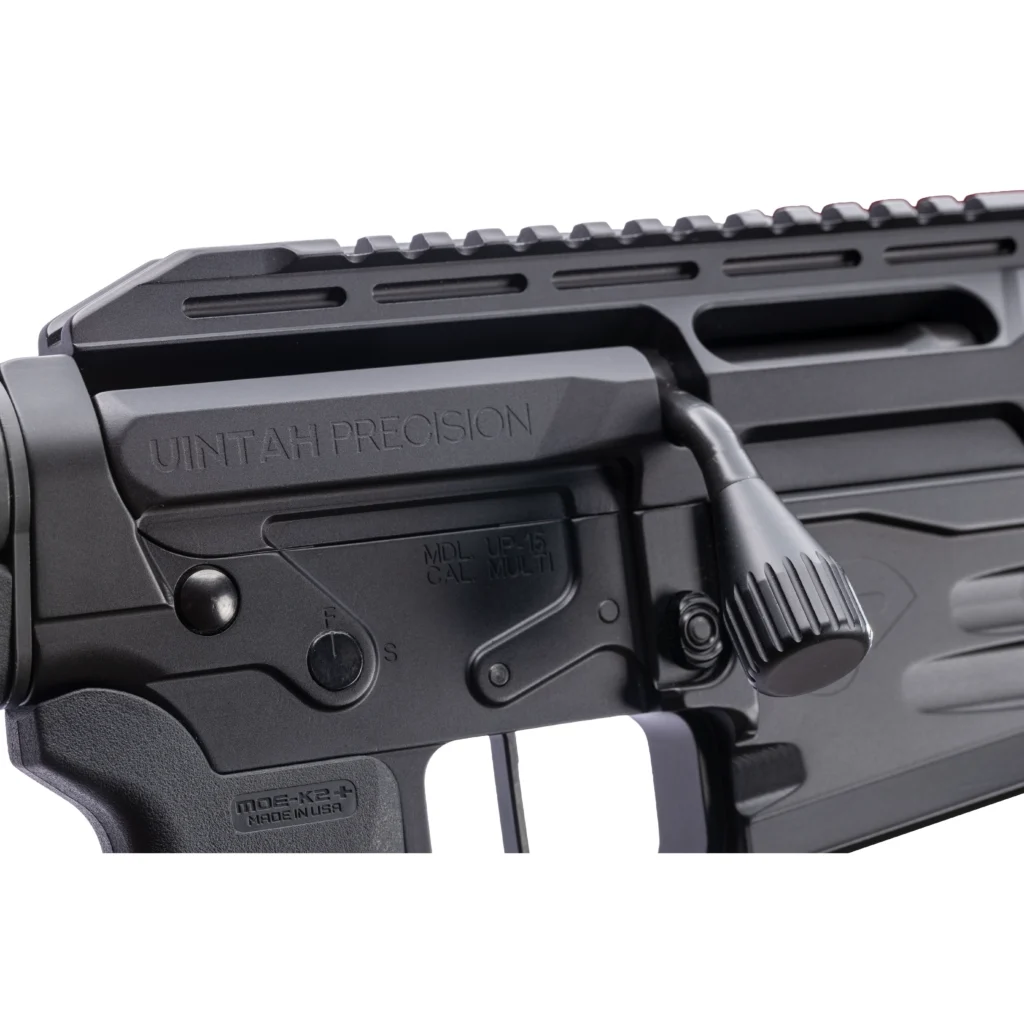
-Our Vitrum trigger is included with every upper purchased.
-Lead times are 10-14 business days to process and ship orders.
–Washington State customers:
Some Washington State FFLs are hesitant to transfer our True Bolt Action AR rifles due to confusion about state law.
Please contact your receiving FFL before purchasing to confirm they will complete the transfer.
If you don’t have a shop selected, we maintain a list of Washington FFLs who understand the law and will process a transfer for our True Bolt Action AR rifles . Contact us to discuss your options.
True Bolt Action AR vs. Semi-Auto AR: What’s the Difference?
Compare a bolt action AR vs semi auto AR and learn how Uintah Precision’s True Bolt Action AR differs in accuracy, suppression, maintenance, follow-up shots, ammunition capability, and AR modularity.
When comparing a bolt action AR vs semi auto AR, the biggest difference is how the rifle operates. The AR platform is best known as a semi-automatic rifle, where gas from a fired cartridge cycles the action, ejects the spent case, loads the next round, and prepares the rifle to fire again with another pull of the trigger.
But semi-automatic operation isn’t the only way to take advantage of the AR platform.
A True Bolt Action AR combines the familiar ergonomics, modularity, magazines, triggers, and accessories of an AR with the manually operated action and many of the performance advantages traditionally associated with a precision bolt-action rifle.
At Uintah Precision, we often describe that combination in three words:
Accurate. Modular. Familiar.
So how does a bolt action AR vs. semi-auto AR actually compare?
The biggest difference is more than simply how the next cartridge gets into the chamber. The operating system affects suppression, ammunition options, precision potential, reliability, maintenance, shooting characteristics, and ultimately what the rifle is best suited to do.
Bolt Action AR vs. Semi-Auto AR: The Basic Difference
A conventional semi-auto AR uses energy generated when the cartridge fires to cycle the rifle’s action automatically.
After each shot, the system unlocks the bolt, extracts and ejects the fired case, resets the hammer, strips another cartridge from the magazine, and chambers it. The shooter can then fire another shot by pulling the trigger again.
A True Bolt Action AR eliminates the automatic cycling process.
The shooter manually operates the bolt after each shot to extract and eject the fired case, cock the hammer, and chamber the next cartridge.
That sounds simple, but removing the gas-operated action fundamentally changes the rifle.
With a purpose-built bolt-action system such as those used by Uintah Precision, the result isn’t simply a semi-auto AR that has been prevented from cycling. The action is designed from the beginning to function as a manually operated precision rifle while retaining the advantages of the AR platform.
A True Bolt Action AR Is Not Just a Semi-Auto AR Without Gas
This distinction is important.
There are ways to turn a conventional AR into a manually operated rifle by eliminating, blocking, or disabling its gas system. The shooter then manually operates the charging handle between shots.
That creates a manually operated AR, but it does not create the same type of action as a purpose-built bolt-action rifle.
Uintah Precision’s True Bolt Action AR uses a dedicated bolt-action design built around a one-piece, three-lug bolt with a 60-degree bolt throw.
The one-piece bolt is an important part of the design. Rather than adapting a conventional multi-component AR bolt and carrier assembly for manual operation, the Uintah system uses a purpose-built bolt engineered specifically for its bolt-action role.
Instead of pulling a conventional AR charging handle straight backward, the shooter operates the action much like a traditional bolt rifle: lift the bolt handle, pull it rearward, push it forward, and rotate it closed.
This gives the rifle the mechanical characteristics of a true bolt-action system while preserving compatibility with key elements of the AR platform.
60-Degree Bolt Throw vs. Traditional AR Charging Handle
One of the most noticeable differences is how the rifle is cycled.
A conventional semi-auto AR normally requires very little shooter interaction with the charging handle once firing begins because the rifle cycles itself.
When a gas-operated AR is converted into a manually operated rifle, however, the charging handle must typically be pulled after every shot.
A Uintah Precision True Bolt Action AR instead uses a 60-degree bolt throw.
The short bolt rotation offers several advantages:
Less hand movement during cycling.
Increased clearance around larger optics.
Faster manual operation.
Less disturbance to the shooter’s position.
Familiar operation for shooters accustomed to precision bolt rifles.
The 60-degree throw is also shorter than the 90-degree bolt lift found on many traditional bolt-action rifles.
For precision shooting—particularly from a bench, bipod, barricade, or supported position—reducing unnecessary movement can make it easier for the shooter to remain behind the rifle and maintain a consistent position between shots.
Semi-Auto Speed vs. Bolt-Action Control
There is one category where the semi-auto AR has an obvious advantage: rate of fire.
A properly functioning semi-automatic AR chambers the next cartridge automatically. For competition, defensive applications, or other situations requiring the fastest possible follow-up shots, that is a significant advantage.
A bolt action requires the shooter to manually cycle the rifle between every shot.
But that doesn’t necessarily mean follow-up shots with a True Bolt Action AR have to be slow.
The smooth operation of the Uintah action, short 60-degree bolt throw, and linear recoil impulse of the AR platform allow an experienced shooter to cycle the action while remaining behind the rifle and quickly return to the target.
Because the rifle recoils straight back into the shooter’s shoulder and the bolt requires relatively little rotational movement, the shooter can maintain position, run the bolt, reacquire the sight picture, and fire again without significantly disrupting the shooting position.
With practice, this allows for rapid follow-up shots and surprisingly quick strings of accurate fire when needed, while still providing the control of a manually operated action.
It won’t match the cyclic speed of a semi-auto—and it isn’t intended to. The advantage is the ability to combine deliberate bolt-action operation with an action that can be cycled quickly and efficiently when the situation calls for it.
For precision shooters, hunters, suppressed shooters, and others, that balance can be more valuable than maximum rate of fire.
They may place greater value on characteristics such as:
Consistency.
Ammunition flexibility.
Reduced gas and mechanical movement.
Suppressor performance.
Mechanical simplicity.
Lower maintenance requirements.
Control over when the action opens.
The ability to make fast, controlled follow-up shots without abandoning the shooting position.
That’s where a purpose-built bolt action AR begins to separate itself from both a conventional semi-auto and a traditional manually operated AR conversion.
Suppressed Shooting: One of the Biggest Differences
Suppressors highlight one of the most significant differences between a bolt action AR and a semi-auto AR.
A conventional gas-operated AR must use part of the gas generated by the cartridge to cycle the action. Adding a suppressor can increase backpressure, which may change bolt velocity and increase the amount of gas, carbon, and fouling directed back through the action.
Depending on the rifle, ammunition, suppressor, and gas system, shooters may address this with adjustable gas blocks, different buffers, springs, or other tuning.
A True Bolt Action AR doesn’t need combustion gas to operate the action.
The action remains locked until the shooter decides to open it.
That provides several advantages for suppressed shooting.
There is no gas system that must be tuned to reliably cycle the rifle, and the shooter controls exactly when the chamber is opened after firing. Just as importantly, the rifle isn’t using a gas system to route combustion gases back through the action every time it fires.
Less Gas Means Less Maintenance
This becomes especially noticeable for shooters who use suppressors extensively.
Suppressors can make conventional semi-auto rifles run considerably dirtier because increased backpressure sends additional carbon and fouling into the operating system.
A Uintah Precision True Bolt Action AR has no gas tube and no gas-operated bolt carrier group to clean. Because the action is manually operated, the rifle avoids much of the fouling associated with cycling a suppressed semi-auto AR.
That means fewer components exposed to gas-system fouling and a simpler maintenance routine—an important advantage for high-volume suppressed shooting.
The purpose-built one-piece bolt further simplifies the operating system. Instead of maintaining a conventional AR bolt and carrier assembly with the components required for gas operation, the shooter is working with a bolt designed specifically for manual operation.
And when the bolt does need to be removed for cleaning or inspection, Uintah Precision’s bolt can be removed without tools.
That combination makes routine maintenance straightforward:
No gas system to tune. No gas-operated carrier assembly to clean. Tool-less bolt removal when maintenance is required.
For shooters trying to build a quiet, simple, low-maintenance suppressed rifle while retaining AR ergonomics and modularity, these are significant advantages.
Ammunition: A Bolt Action Doesn’t Have to Cycle a Gas System
A semi-automatic rifle must do more than safely contain the pressure generated by a cartridge.
The ammunition also has to work with the rifle’s operating system.
Gas pressure, dwell time, bolt velocity, buffer weight, spring rate, barrel length, suppressor use, and ammunition characteristics can all influence semi-auto operation.
A bolt-action rifle doesn’t have that requirement.
There is no need for the ammunition to generate the correct gas characteristics to cycle the action.
This becomes particularly interesting with cartridges and ammunition developed specifically to take advantage of bolt-action strength.
Federal’s +Peak ammunition uses a high-strength Peak Alloy case while maintaining the external dimensions of standard 6.5 Creedmoor ammunition. Federal lists a maximum average pressure of 80,000 psi and advertises velocity increases of up to approximately 300 fps compared with conventional 6.5 Creedmoor loads.
That type of ammunition illustrates an important difference between the two platforms:
A True Bolt Action AR shouldn’t necessarily be limited to ammunition performance dictated by a semi-automatic operating system.
Ammunition compatibility is always specific to the rifle, chambering, and manufacturer’s approval. Shooters should never assume that higher-pressure ammunition is safe in a firearm unless the firearm manufacturer specifically approves it.
Precision and Mechanical Movement
Both semi-auto and bolt-action ARs can be extremely accurate.
A quality semi-auto AR with a good barrel, ammunition, trigger, optic, and shooter can produce excellent groups.
The difference is in what happens mechanically when the rifle fires.
A semi-auto begins its operating cycle automatically after ignition. Gas enters the operating system, the bolt carrier begins moving, the action unlocks, and the rifle cycles.
A bolt action remains mechanically locked until the shooter chooses to cycle it.
For a rifle built primarily around precision, that simplicity is attractive.
Uintah Precision builds its True Bolt Action AR systems around tight manufacturing tolerances and match-grade barrels. The company’s rifles carry a sub-MOA accuracy guarantee with qualifying factory match ammunition.
Many Uintah shooters have reported groups considerably smaller than one MOA, including sub-.5 MOA performance with appropriate factory ammunition, although those results should not be interpreted as a guarantee that every rifle and ammunition combination will produce half-MOA groups.
Accuracy still depends on ammunition, environmental conditions, shooting technique, optics, rifle setup, and other variables.
This is the first part of what we mean by:
Accurate. Modular. Familiar.
AR Modularity Without Semi-Automatic Operation
One of the primary reasons the AR became so popular is modularity.
Triggers, grips, stocks, magazines, optics, bipods, rails, and other components can be configured around the individual shooter and application.
Traditional precision bolt rifles can also be highly configurable, but they often require specialized chassis systems, bottom metal, magazines, triggers, or gunsmithing.
A True Bolt Action AR takes a different approach.
The Uintah Precision UPR functions much like a precision barreled action designed to pin directly to a compatible AR lower.
That allows shooters to retain much of what they already like about the AR platform while changing the operating system of the rifle.
Depending on the Uintah model and configuration, shooters can take advantage of familiar AR components including:
AR-compatible lower receivers.
AR-pattern magazines.
AR trigger systems.
Familiar pistol grips and stocks.
Common optics and mounting solutions.
Rail-mounted accessories.
That’s the Modular part.
For someone who already owns and understands the AR platform, the learning curve can be considerably smaller than moving to an entirely different precision-rifle ecosystem.
That’s the Familiar part.
Accurate. Modular. Familiar.
It’s a simple way to describe what a True Bolt Action AR is intended to accomplish.
Trigger Operation Is Different From a Traditional Bolt Rifle
Another interesting difference is what happens when the bolt is cycled.
On many traditional bolt-action rifles, lifting and cycling the bolt is part of cocking the rifle’s internal firing mechanism. Depending on the design, the shooter may feel spring resistance during bolt operation.
A Uintah Precision True Bolt Action AR uses the hammer and trigger system in the AR lower receiver.
The bolt itself isn’t being used to compress a conventional firing-pin spring during bolt lift.
Instead, rearward bolt movement resets the AR hammer.
This contributes to the feel of the Uintah action and is another example of how the design combines characteristics of a traditional bolt rifle with the architecture of an AR.
Reliability and Maintenance
Both systems can be extremely reliable when properly designed and maintained, but they accomplish that reliability differently.
A semi-auto AR depends on several systems working together correctly. Gas flow, bolt-carrier movement, buffer weight, spring tension, magazine function, ammunition, and other factors all contribute to reliable cycling.
A bolt-action AR removes the requirement for the rifle to cycle automatically.
There is no gas tube or gas block required to operate the action, and there is no need to tune the gas system around a suppressor or a particular ammunition load simply to make the rifle cycle.
The shooter supplies the energy needed to extract, eject, and chamber each round.
The one-piece bolt and simplified manual operating system also make routine maintenance straightforward. The bolt can be removed from the Uintah action without tools, allowing quick access for cleaning, inspection, or lubrication.
This is particularly valuable on suppressed rifles, where eliminating the gas-operated cycling system means substantially less fouling is being routed through the action compared with a conventional suppressed semi-auto.
This doesn’t make a bolt-action rifle maintenance-free or immune to malfunctions and wear. It does, however, eliminate several components and maintenance variables associated specifically with gas-operated automatic cycling.
Bolt Action AR vs. Traditional Bolt Rifle
The comparison isn’t limited to semi-autos.
A True Bolt Action AR also occupies an unusual position relative to conventional precision bolt rifles.
A traditional custom bolt rifle may offer exceptional accuracy, strength, and refinement, but building one can require a receiver, barrel, stock or chassis, trigger, bottom metal, magazines, and gunsmithing.
High-end custom builds can approach or exceed several thousand dollars, with some configurations reaching or exceeding $6,000.
Uintah Precision takes a different route.
The UPR system can provide the shooter with a purpose-built precision bolt action and match-grade barrel while using a compatible AR lower as the foundation.
In practical terms, it can be thought of as:
A precision barreled action that pins to your AR lower.
For shooters who already own a suitable lower—or who want the modularity of the AR platform—that can provide a different path to custom-rifle-level performance without the traditional custom-rifle architecture or cost.
Which Is Better: Bolt Action AR or Semi-Auto AR?
Neither operating system is universally better.
They are optimized for different priorities.
A semi-auto AR generally makes more sense when maximum rate of fire and the fastest possible follow-up shots are primary requirements.
A True Bolt Action AR becomes particularly compelling when the priorities are precision, suppressed shooting, ammunition flexibility, simple maintenance, manual control, or combining bolt-rifle characteristics with AR modularity.
And choosing a bolt action doesn’t mean giving up the ability to shoot quickly when necessary. The smooth Uintah action, short 60-degree bolt throw, and straight-line recoil characteristics of the AR platform allow a practiced shooter to produce fast, controlled follow-up shots and rapid strings of accurate fire while staying behind the rifle.
The question isn’t simply:
“Which rifle is better?”
A better question is:
“What do I need the rifle to do?”
For maximum shooting speed, a semi-auto has an obvious advantage.
For a precision-oriented rifle where every shot is deliberate—but a quick second, third, or subsequent shot may still be required—the design of a purpose-built True Bolt Action AR provides an effective middle ground.
Why Uintah Precision Built a True Bolt Action AR
Uintah Precision didn’t approach the problem by simply removing the gas system from a conventional AR.
The goal was to combine two proven concepts:
The strength and precision potential of a true bolt action with the modularity and familiarity of the AR platform.
That led to a purpose-built one-piece, three-lug bolt, 60-degree bolt throw, AR-compatible trigger system, double-stack magazine feeding, match-grade barrel system, and user-configurable AR architecture.
It also resulted in a simple operating system that’s easy to maintain, particularly when suppressed, with a bolt that can be removed without specialized tools.
The result is a rifle that doesn’t fit neatly into the traditional categories.
It isn’t a semi-auto AR converted to manual operation.
It isn’t a conventional bolt rifle placed into an AR-looking chassis.
It’s a True Bolt Action AR.
Accurate. Modular. Familiar.
Frequently Asked Questions
Is a bolt action AR the same as an AR with the gas system removed?
No. A conventional AR with its gas system disabled becomes manually operated, but it still uses an action originally designed around semi-automatic operation. A purpose-built True Bolt Action AR uses a dedicated bolt-action mechanism designed specifically for manual operation.
Does a Uintah Precision True Bolt Action AR use a standard AR bolt carrier group?
No. The Uintah system uses a purpose-built one-piece bolt designed specifically for its bolt-action operating system rather than relying on a conventional gas-operated AR bolt carrier group.
How do you remove the bolt from a Uintah Precision bolt action AR?
The bolt is designed for tool-less removal, making it straightforward to remove for routine cleaning, inspection, and lubrication without specialized tools.
Is a True Bolt Action AR easier to maintain when shooting suppressed?
In many respects, yes. Because there is no gas-operated cycling system routing combustion gas and suppressor-induced backpressure through the action, the operating system generally experiences less of the fouling associated with suppressed semi-auto ARs. The simplified one-piece bolt and tool-less removal further simplify routine maintenance.
How fast can you shoot a bolt action AR?
A semi-auto AR will inherently cycle faster because the action operates automatically. However, the smooth Uintah Precision action, short 60-degree bolt throw, and linear recoil characteristics of the AR platform allow a practiced shooter to maintain position and make rapid, controlled follow-up shots. This can also allow quick strings of accurate fire when the situation requires them.
Is a bolt action AR more accurate than a semi-auto AR?
Not automatically. High-quality semi-auto ARs can be extremely accurate. A purpose-built bolt action eliminates the automatic cycling system and provides a mechanically simple platform optimized around precision, but actual accuracy depends on the rifle, barrel, ammunition, optics, conditions, and shooter.
Is a bolt action AR better for suppressors?
It can offer significant advantages. Because the action doesn’t automatically open after firing and no gas system is required to cycle the rifle, a bolt action AR avoids many of the gas, fouling, and tuning issues associated with suppressed semi-auto ARs.
Can a bolt action AR use normal AR magazines?
Uintah Precision True Bolt Action AR models are designed around compatible AR-pattern magazines appropriate to their platform and chambering.
Can a bolt action upper go on a regular AR lower?
Compatible Uintah Precision UPR models are designed to attach to appropriate AR-pattern lower receivers. Compatibility depends on the model, lower, caliber, and configuration, so shooters should verify compatibility before purchasing.
Can a bolt action AR use an AR trigger?
Uintah Precision’s system uses the trigger and hammer in a compatible AR lower, allowing shooters to use appropriate AR trigger systems.
Can a bolt action AR shoot higher-pressure ammunition?
Only when the firearm manufacturer specifically approves the ammunition for that firearm and chambering. Uintah Precision has tested and approved Federal Premium 6.5 Creedmoor +Peak for compatible Uintah 6.5 Creedmoor configurations. Higher-pressure ammunition should never be used solely because a firearm happens to be bolt operated.
What is the advantage of a 60-degree bolt throw?
A shorter bolt lift reduces the amount of hand movement required to cycle the action and provides additional clearance around optics compared with many traditional 90-degree bolt actions.
Who is a True Bolt Action AR for?
It can be particularly well suited to precision shooters, hunters, suppressed shooters, law-enforcement or professional users, and AR owners who want bolt-action characteristics without giving up the modularity and familiarity of the AR platform.
The Bottom Line
The difference between a bolt action AR and a semi-auto AR goes far beyond how quickly the rifle fires.
A semi-auto AR uses the energy generated by the cartridge to cycle automatically. That’s ideal when maximum rate of fire is the priority.
A True Bolt Action AR puts the shooter in control of the operating cycle while eliminating the gas system and retaining much of the modularity that makes the AR platform so useful.
And manual operation doesn’t have to mean slow operation. The smooth action, short 60-degree bolt throw, and linear recoil impulse allow a practiced shooter to stay behind the rifle and deliver quick, controlled follow-up shots when needed.
The purpose-built one-piece, three-lug bolt, simplified maintenance, tool-less bolt removal, and clean suppressed operation further separate the design from a conventional AR that has simply had its gas system disabled.
For shooters focused on precision, suppression, ammunition capability, and deliberate shot placement—while retaining the ability to make fast follow-up shots—that combination creates a unique alternative to both conventional semi-auto ARs and traditional bolt rifles.
To provide the best experiences, we use technologies like cookies to store and/or access device information. Consenting to these technologies will allow us to process data such as browsing behavior or unique IDs on this site. Not consenting or withdrawing consent, may adversely affect certain features and functions.
Functional
Always active
The technical storage or access is strictly necessary for the legitimate purpose of enabling the use of a specific service explicitly requested by the subscriber or user, or for the sole purpose of carrying out the transmission of a communication over an electronic communications network.
Preferences
The technical storage or access is necessary for the legitimate purpose of storing preferences that are not requested by the subscriber or user.
Statistics
The technical storage or access that is used exclusively for statistical purposes.The technical storage or access that is used exclusively for anonymous statistical purposes. Without a subpoena, voluntary compliance on the part of your Internet Service Provider, or additional records from a third party, information stored or retrieved for this purpose alone cannot usually be used to identify you.
Marketing
The technical storage or access is required to create user profiles to send advertising, or to track the user on a website or across several websites for similar marketing purposes.
-Our Vitrum trigger is included with every upper purchased.
-Lead times are 10-14 business days to process and ship orders.
-Left handed options should be available in June.
–Washington State customers:
Some Washington State FFLs are hesitant to transfer our True Bolt Action AR rifles due to confusion about state law.
Please contact your receiving FFL before purchasing to confirm they will complete the transfer.
If you don’t have a shop selected, we maintain a list of Washington FFLs who understand the law and will process a transfer for our True Bolt Action AR rifles . Contact us to discuss your options.